
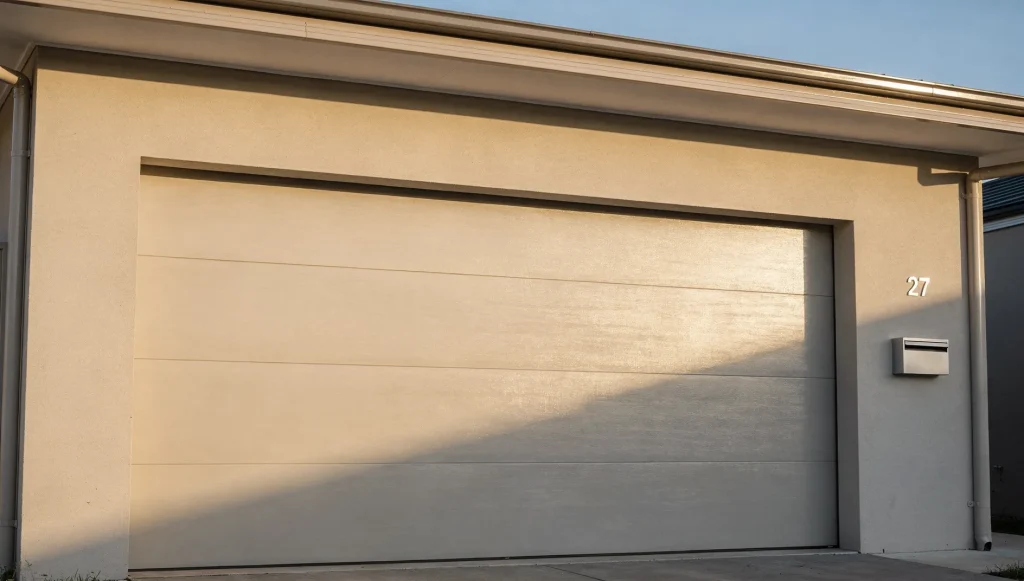
Ever noticed a garage door that looks tired, chalky or slightly warped years before you’d expect? More often than not, the sun is the culprit. Perth’s long summers and high UV index age exterior surfaces faster than many homeowners anticipate, and a garage door that faces the afternoon sun takes the brunt of it. The important thing to understand is that UV protection for garage doors Perth starts long before a door fades — at the point of specification and fitting. Choosing the right material and finish during professional garage door installation Perth gives you the best chance of a door that holds its colour and shape for the long haul.
How Perth Sun and UV Exposure Damages Garage Doors
Solar damage rarely arrives all at once. It builds slowly, which is part of why it catches people off guard. Over time, ultraviolet light breaks down the pigments in paint and coatings, leading to visible fading and an uneven, washed-out look.
Beyond colour loss, intense heat and UV cause a few other recognisable problems:
- Surface chalking — a dull, powdery residue that appears as the top layer of the finish degrades.
- Panel warping — repeated heating and cooling can flex and distort panels, especially on larger doors.
- Heat stress on frames — constant thermal expansion puts strain on the frame, seals and fixings over years of exposure.
- Finish breakdown — protective coatings thin out, leaving the base material more vulnerable.
Each of these shortens the practical life of a door and affects how it looks from the street.
Material Choices That Resist UV
The single biggest factor in how a door handles the sun is what it’s made from. Each material behaves differently under heat and prolonged UV exposure.
- Steel and Colorbond sheet — widely used and valued for strength. Quality factory-applied coatings on steel sheet are designed to hold colour and resist fading, making them a common choice for Perth conditions.
- Aluminium — lightweight and resistant to corrosion, aluminium handles heat well and suits coastal and custom designs. Its surface finish still matters for long-term UV resistance.
- Composite panels — engineered materials that can offer a timber-look appeal with better dimensional stability than natural timber under heat.
No material is immune to the sun, but a well-specified door built with UV in mind performs far better over its life than a generic option chosen on looks alone.
Colour and Finish Decisions
Colour is not just about street appeal — it directly influences how a door copes with heat. Lighter tones reflect more sunlight and absorb less heat, which reduces thermal stress and helps the finish last longer. Quality coatings are formulated to hold their colour and shield the material beneath.
Darker shades and popular greys look striking, and many homeowners want them, but they absorb more heat and can show fading sooner in direct sun. That doesn’t rule them out. It simply means a darker or custom colour benefits from a high-grade coating and, ideally, a position that isn’t baking in full afternoon sun all day.
Orientation, Design and Shading Factors
Where a door sits on your home changes how hard the sun works on it. A door facing north or west in Perth catches the most intense, prolonged exposure, while a south-facing door is naturally shielded for much of the day.
You can’t always change orientation, but home design can soften the impact. Eaves, a porch, a carport extension or even landscaping can cast shade across the door and frame during the hottest hours. Factoring this in when planning a new door, or choosing a tougher finish for an exposed aspect, makes a real difference to how slowly UV damage appears.
Protective Coatings and Surface Care Over Time
UV defence isn’t only a one-off decision at fitting. Over the years, surfaces benefit from attention that keeps their protective layer intact. Gently washing off dust, salt and grime stops abrasive build-up that wears coatings down, and this fits alongside the broader checks covered in our guide to maintaining a newly installed garage door.
Where a finish has started to dull or chalk, re-sealing or re-coating certain materials can restore a layer of protection and refresh appearance. Whether that’s practical depends on the door’s material and condition, so it’s worth getting an informed assessment rather than assuming any door can simply be painted over.
Why Getting Material and Finish Right at Installation Matters
Retro-fitting UV resistance is always harder than building it in from the start. When the material, colour and finish are matched to the door’s orientation and the local climate at the point of installation, you get a door that resists fading, warping and surface breakdown for years with far less intervention.
That’s why these choices deserve genuine thought rather than being treated as cosmetic. A door specified well for Perth’s sun is, in effect, an investment in its own lifespan.
Because UV-resistant materials and quality finishes are an investment in how long a door lasts, it pays to understand exactly what protection and coverage comes with a new door, and how your material and finish choices relate to the assurances offered on it. Knowing how coverage and assurances on garage doors work helps you make confident, lasting decisions about the door on your home.