
Most people put up with a rattle, a squeak or a slightly sluggish garage door for weeks – right up until the door fails completely, usually when they’re already running late. The trouble is that a few of these small quirks are early signals of a serious problem, and knowing when to call a local garage door repair team early can stop a minor fault from becoming a dangerous failure. This article helps you tell the difference between something that can wait and something that can’t.
Prefer to watch or listen?
Listen onApple Podcasts
Sudden Changes in Sound, Movement or Balance
The clearest sign a fault has escalated is a sudden change. A door that has always opened smoothly and now lurches, hesitates or makes a noise it never made before is telling you something shifted internally.
Pay close attention to balance. If the door feels much heavier than usual, drifts when you stop it halfway, or no longer holds its position, a load-bearing component is likely under strain. These changes rarely fix themselves, and they tend to get worse quickly once they start.
Safety-Critical Warning Signs
Some symptoms move straight to the top of the priority list because they put people, pets and vehicles at real risk. Stop using the door and arrange help if you notice any of the following:
- The door slams shut or drops faster than it should during closing.
- The door reverses on its own or won’t complete its travel.
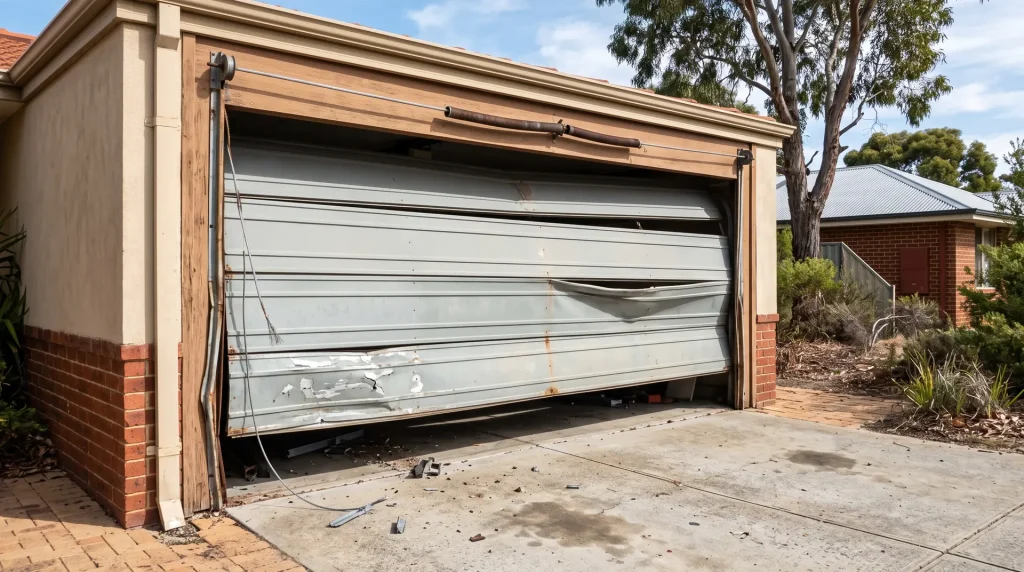
- The door visibly sags, bows or leans under its own weight.
- The door will not stay open and creeps downward once released.
A door that can fall unexpectedly is one of the most dangerous faults in the home. Treat these signs as urgent, not as an inconvenience you can work around for a few more days.
Visible Physical Damage
You can spot many serious problems just by looking – no tools required. A quick visual check often reveals whether a door has crossed from wear into failure.
- Cables that are frayed, loose or hanging away from their normal path.
- A spring with a visible gap, separation or coil that looks stretched.
- Tracks that are bent, twisted or pulling away from the wall.
- Cracked, split or buckled panels.
Springs and cables hold enormous tension, so visible damage to either should never be tested by continuing to operate the door. Bent tracks are another common trigger for a door leaving its guides, and if that has already happened it’s worth understanding why garage doors go off track so you don’t force the door and cause further harm.
Performance Red Flags
Not every warning sign is loud or dramatic. Performance problems can build slowly, and they’re easy to dismiss until the door stops altogether. Watch for:
- Jerky or juddering movement instead of a smooth run.
- One side lifting faster than the other, so the door sits crooked.
- A noticeable delay between the command and the door responding.
- The door opening only partway before stalling.
Any of these suggests a component is struggling to do its job. On their own they may not be an immediate emergency, but combined with the safety signs above they point to a system under real stress.
Why Delaying an Urgent Repair Makes Things Worse
Putting off an urgent repair rarely saves you anything. A door that’s already straining puts extra load on every part it relies on, so a single failing component quickly drags others down with it. What starts as one worn part can become several by the time the door finally stops.
There’s a safety cost too. Every operation of a compromised door is another chance for a cable to let go or a panel to give way while someone is standing underneath. The longer the door runs in that state, the higher the risk and the larger the eventual scope of work.
How to Stay Safe While You Wait
If your door is showing serious warning signs, the safest step is simply to stop using it. Continuing to open and close a faulty door invites the exact failure you’re trying to avoid.
- Stop operating the door and leave it in the safest position – fully open if it’s stuck open, fully closed if it’s already down.
- Keep people, vehicles and pets clear of the doorway and never stand beneath a door that won’t hold position.
- Do not attempt to adjust or release springs or cables yourself, as the stored tension can cause injury.
- If you must access the garage, use an alternative entry until the door has been inspected.
- Arrange a professional call-out and describe exactly what you’ve noticed so the visit is prepared correctly.
Acting on the warning early protects both you and the door, and it usually keeps the repair contained rather than letting it spread.
Many of these sudden failures aren’t as random as they seem. They often follow a stretch of quiet strain on springs, seals and moving parts – and in Perth that strain is frequently environmental. Extreme temperature swings gradually weaken the very components behind the warning signs above, which is why it’s worth understanding how local climate conditions accelerate wear on your garage door long before it fails.